Table Of Content
- Generalized randomized block design
- What is a Randomized Block Experiment?
- Contents
- Content Preview
- Study design
- No Blocking Variable vs. Having a Blocking Variable
- Randomized Block Experiments: Data Analysis
- Randomization, design and analysis for interdependency in aging research: no person or mouse is an island

Randomized block design still uses ANOVA analysis, called randomized block ANOVA. When participants are placed into a block, we anticipate them to be homogeneous on the control variable, or the blocking variable. In other words, there should be less variability within each block on the control variable, compared to the variability in the entire sample if there were no control variable. Less within-block variability reduces the error term and makes estimate of the treatment effect more robust or efficient, compared to without the blocking variable. Furthermore, as mentioned early, researchers have to decide how many blocks should there be, once you have selected the blocking variable.
Generalized randomized block design
You will note that variety A appears once in each block, as does each of the other varieties. Formal test of interaction effects between blocks and treatments for a randomized block design. Can also considered for testing additivity in 2-way analyses when there is only one observation per cell.
What is a Randomized Block Experiment?
This can cause a problem if, for example, it happens that after running the experiment, it turns out that the blocking variable is less important than we actually thought. In order to force equality between the study groups regarding multiple variables, we need to block on all of them. The number of subgroups created will be the product of the number of categories in each of these variables. In the present study, the total number of patients who developed postoperative complications such as nausea, vomiting, bradycardia, hypotension, phrenic paresis, and Horner's syndrome was comparable between the two groups.
Contents
The papers were assigned to three categories “Design acceptable”, “Randomised to treatment groups”, so of doubtful validity, or “Room for improvement”. Only 32 ± 4.7% of the papers fell into the first group, although none of them actually named either the CR or RB design. Second, the blocking variable cannot interact with the independent variable. In the example above, the cell phone use treatment (yes vs. no) cannot interact with driving experience. This means the effect of cell phone use treatment (yes vs. no) on the dependent variable, driving ability, should not be influenced by the level of driving experience (seasoned, intermediate, inexperienced). In other words, the impact of cell phone use treatment (yes vs. no) on the dependent variable should be similar regardless of the level of driving experience.
Content Preview
For patients undergoing anterior cervical spine surgery, the intermediate cervical plexus block does not provide better postoperative regional analgesia compared to the cervical erector spinae block. Performance time and onset time were shorter in the IC group, whereas nalbuphine consumption was lower in the ES group. With the increasing number of nerve block techniques available, anesthesiologists may have difficulty determining the most appropriate technique to achieve optimal recovery after anterior cervical spine surgery. Therefore, this study was conducted to compare the analgesic effects of ultrasound-guided intermediate cervical plexus block and cervical erector spinae block in patients undergoing anterior cervical spine surgery. Regional analgesia techniques are crucial for pain management after cervical spine surgeries. Anesthesiologists strive to select the most effective and least hazardous regional analgesia technique for the cervical region.
Training with noninvasive brain–machine interface, tactile feedback, and locomotion to enhance neurological recovery ... - Nature.com
Training with noninvasive brain–machine interface, tactile feedback, and locomotion to enhance neurological recovery ....
Posted: Tue, 29 Nov 2022 08:00:00 GMT [source]
In a completely randomized design, treatments are assigned to experimental units at random. This is typically done by listing the treatments and assigning a random number to each. Combining the two species, 32 ± 4.7% of the papers were judged to have been designed and randomised to an acceptable standard, although none of them stated that they had used either the CR or RB design. Scientists wishing to build repeatability into their experiments could use the RB design, spreading the blocks over a period of time.
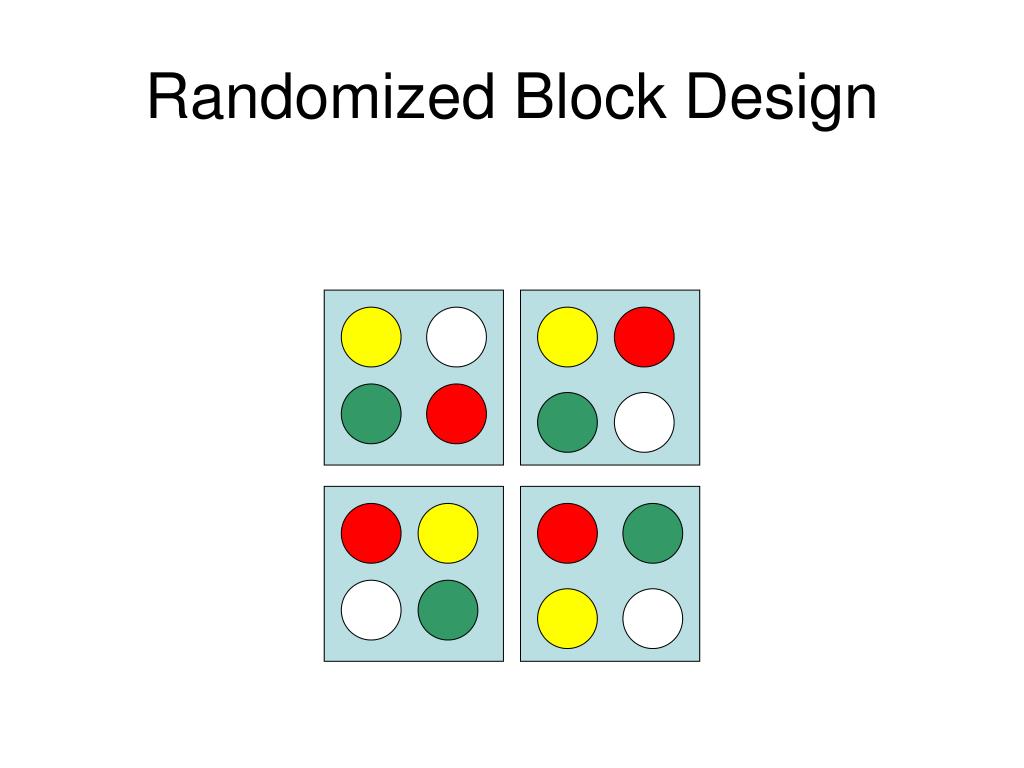
This happens automatically if subjects are only identified by their identification number once the treatments have been given. In each of the partitions within each of the five blocks, one of the four varieties of rice would be planted. In this experiment, the height of the plant and the number of tillers per plant were measured six weeks after transplanting. The taller the plant and the greater number of tillers, the healthier the plant is, which should lead to a higher rice yield. That is , if the experiment was repeated, a new sample of i batches would be selected,d yielding new values for \(\rho_1, \rho_2,...,\rho_i\) then.
Just like in the example above, driving experience has an impact on driving ability. This is why we picked this particular variable as the blocking variable in the first place. Even though we are not interested in the blocking variable, we know based on the theoretical and/or empirical evidence that the blocking variable has an impact on the dependent variable. By adding it into the model, we reduce its likelihood to confound the effect of the treatment (independent variable) on the dependent variable. If the blocking variable (or the groupings of the block) has little effect on the dependent variable, the results will be biased and inaccurate. We are less likely to detect an effect of the treatment on the outcome variable if there is one.
Fentanyl 0.5 ug/kg was administered based on the heart rate and mean arterial blood pressure of patients, if it increased by more than 20% from the baseline measurement after excluding other causes. Mechanical ventilation was adjusted to maintain ETCO2 (end tidal CO2) at 35 to 40 mmHg. The calculator reports that the probability that F is greater than 1.33 equals about 0.19. All rights are reserved, including those for text and data mining, AI training, and similar technologies.
Customized three-dimensional printed ceramic bone grafts for osseous defects: a prospective randomized study ... - Nature.com
Customized three-dimensional printed ceramic bone grafts for osseous defects: a prospective randomized study ....
Posted: Sat, 10 Feb 2024 08:00:00 GMT [source]
With a randomized block experiment, the main hypothesis test of interest is the test of the treatment effect(s). A randomized block design with the following layout was used to compare 4 varieties of rice in 5 blocks. If the experimenter focuses exclusively on the differences between treatments, the effects due to variations between the different blocks should be eliminated. The objective of the randomized block design is to form groups where participants are similar, and therefore can be compared with each other. It is likely that the use of lower concentrations and smaller volumes of local anesthetics minimizes the spread under the prevertebral fascia. In experienced hands bilateral intermediate block is considered a safe analgesic technique [29, 30].
In these cases, manually reducing variability between groups by using a randomized block design will offer a gain in statistical power and precision compared to a completely randomized design. An investigator wishes to compare a family-based educational intervention for childhood weight loss with a standard individual-base program. A planned enrollment of 250 participants, 50 per study site, is to be randomly assigned to the two intervention arms. Below, a computer algorithm written in SAS® (Cary, NC) is presented for performing a block randomization with randomly selected block sizes of 4, 8 and 12 (Figure 1). The macro generates 15 randomized block allocations each for 5 study sites. A greater number of blocks are created than is necessary in the event that the investigator continues enrollment beyond the initially planned sample size.
A premise of basic statistical tests of significance is that underlying observations are independently and identically distributed. The stochastic assignment of participants helps to satisfy this requirement. It also allows the investigator to determine whether observed differences between groups are due to the agent being studied or chance. After identifying the experimental unit and the number of replications that will be used, the next step is to assign the treatments (i.e. factor levels or factor level combinations) to experimental units.
The spread of local anesthetic from the erector spinae plane to the epidural or paravertebral space depends above all on the volume of injected local anesthetic. Potential complications include circulatory changes (hypotension), unintended motor blockades and possible systemic toxicity at high LA doses. In adults, it is considered safe to use a local anesthetic volume of 20 to 30 ml [3, 23, 27, 28]. Two patients were excluded from the study—one patient did not complete the study and the surgery plan was changed for the other patient. The remaining 58 patients were randomly divided into two equal groups of 29 each (Fig. 3).
This assignment can then be used to apply the treatment levels appropriately to pots on the greenhouse bench. Other methods and heuristics for block-treatment interaction in unreplicated studies are surveyed in the monograph Milliken & Johnson (1989). A similar search in Pubmed on “rat” and “experiment” found 483,490 papers. The first 50 of these with even identification numbers were published between 2015 and 2020.


No comments:
Post a Comment